
Sleep Hacks Explained in Under 3 Minutes: Why Your Workout Results Depend on It
You can train with perfect form, nail your nutrition timing, and follow the most advanced programming available. But if you're sleeping poorly, you're essentially throwing money down the drain on gym memberships and supplements.
The research is clear: sleep is your primary recovery time—the window when your body repairs, adapts, and actually gets stronger—so recovery is non-negotiable for results. And most adults are chronically under-sleeping, then wondering why their strength plateaus, their energy crashes, and their body composition stays stuck.
Here's what the science shows and what you can do about it, explained in three minutes.
The Performance Impact You Can't Ignore
When Stanford researchers had basketball players extend their sleep to 10 hours per night, shooting accuracy improved by 9%, sprint times got faster, and overall athletic performance jumped significantly. That's from sleep alone: no new training program, no supplements, no coaching changes.
On the flip side, sleep restriction hits performance hard. Studies show that losing just a few hours of sleep reduces maximum power output by 15 watts and decreases both average and peak performance. Your perceived exertion increases, meaning the same workout feels harder when you're sleep-deprived.
For the average person training 3-4 times per week, this translates to weaker lifts, slower recovery between sets, and that sluggish feeling that makes you want to cut workouts short.
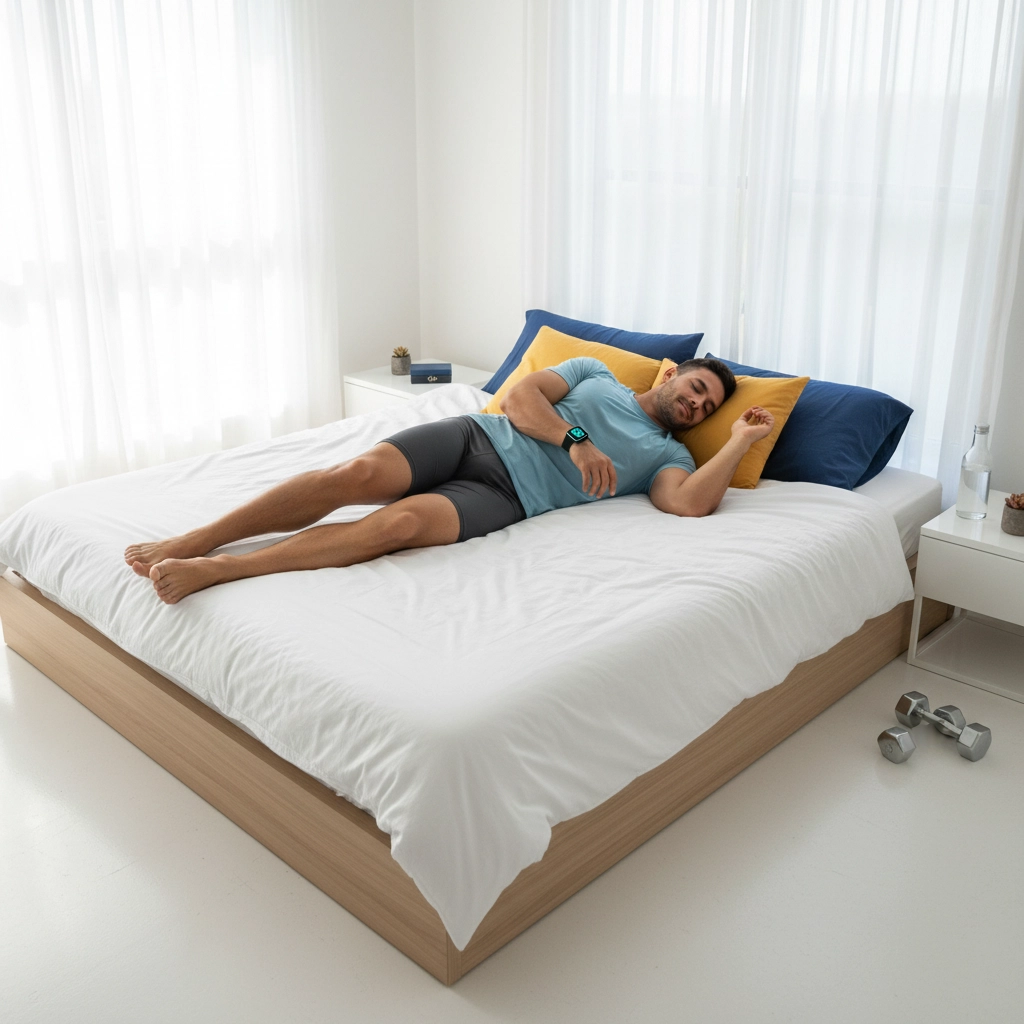
What Actually Happens When You Sleep
Your body doesn't just "rest" during sleep: it gets busy with the real work of adaptation. Deep sleep stages trigger growth hormone release, which transports proteins directly to your muscles. This is when muscle protein synthesis peaks and when your body repairs the microscopic damage from training.
Sleep also regulates cortisol, your primary stress hormone. When cortisol stays elevated from poor sleep, your body struggles to build muscle and preferentially stores fat, particularly around the midsection. This is why people who consistently sleep poorly often see their body composition move in the wrong direction despite consistent training.
Additionally, adequate sleep optimizes insulin sensitivity, meaning your muscles more effectively use the carbohydrates you eat for energy and recovery rather than storing them as fat.
The Sleep Targets That Actually Work
Most adults need 7-9 hours of sleep, but if you're training regularly, you're likely on the higher end of that range. Athletes consistently perform better with 9-10 hours, and there's no reason to think recreational trainees are different: your body still needs time to adapt to the stress you're placing on it.
Quality matters as much as quantity. You need sufficient deep sleep phases, which is where growth hormone release peaks. This means creating conditions for uninterrupted sleep, not just lying in bed for 8 hours scrolling your phone.

Strategic Napping for Better Results
If your schedule makes 8-9 hours of nightly sleep difficult, strategic napping can help bridge the gap. The research supports naps of 30-90 minutes between noon and 3 PM for performance benefits.
Shorter naps (20-30 minutes) can help with alertness but don't provide the deeper recovery benefits. Longer naps (60-90 minutes) allow you to complete full sleep cycles, which is where the real recovery happens.
The timing matters: napping after 3:30 PM interferes with nighttime sleep for most people. And napping won't fully replace lost nighttime sleep, but it can help maintain performance when your main sleep is compromised.
Practical Implementation Strategies
Set a consistent bedtime. Your circadian rhythm thrives on consistency. Going to bed at the same time every night: including weekends: makes falling asleep easier and improves sleep quality.
Create a pre-sleep routine. Start winding down 60-90 minutes before bed. This doesn't mean meditation or elaborate rituals: just dimming lights, putting devices away, and doing something quiet and non-stimulating.
Optimize your sleep environment. Keep your bedroom cool (65-68°F), dark, and quiet. Blackout curtains and white noise machines are worthwhile investments if your environment isn't naturally conducive to sleep.
Time your training wisely. High-intensity exercise within 3-4 hours of bedtime can interfere with falling asleep for some people. If you train in the evening and struggle with sleep, experiment with earlier workout times.

Addressing the Common Obstacles
"I don't have time for 8 hours of sleep" is the most common pushback, but it's worth examining the math. If better sleep improves your training quality, cognitive function, and energy levels, you're likely more productive in the hours you are awake. Many people find they need less "downtime" when they're well-rested.
"I can't fall asleep earlier" often comes down to light exposure and stimulus control. Using devices right up until bedtime keeps your brain alert. Try setting a "device curfew" 60 minutes before your target bedtime and see how it affects your ability to wind down.
"I wake up in the middle of the night" can be related to blood sugar drops, stress, or environmental factors. If you're waking consistently around the same time, examine what might be causing it: room temperature, noise, or timing of your last meal.
The Recovery-Performance Connection
Quality sleep doesn't just help with muscle building: it's crucial for your nervous system recovery. Your central nervous system needs to recover from training stress just like your muscles do, and this happens primarily during sleep.
When your nervous system is well-recovered, you can generate more force, have better coordination, and maintain higher training intensities. When it's not, everything feels harder, even though the weights haven't changed.
Sleep also affects motivation and decision-making. Well-rested people are more likely to stick to their training schedule, make better food choices, and have the mental energy to push through challenging workouts.

Making It Sustainable
Don't try to overhaul your sleep habits overnight. Pick one area to focus on first: maybe it's setting a consistent bedtime or eliminating screens before bed. Once that becomes automatic, add another element.
Track your sleep for a few weeks to establish patterns. Most people underestimate how much sleep they need and overestimate how much they're actually getting. A simple sleep diary or wearable device can provide useful data.
Remember that sleep quality can be just as important as quantity. Eight hours of fragmented, poor-quality sleep won't deliver the same benefits as seven hours of deep, uninterrupted sleep.
The Bottom Line on Sleep and Training
If you're serious about your training results, sleep can't be an afterthought. It's not about perfection: it's about consistency and making sleep a priority rather than something that happens after everything else is done.
The clients I work with who make the biggest improvements in strength, energy, and body composition are the ones who address their sleep alongside their training and nutrition. It's not the most exciting topic, but it's one of the highest-impact changes you can make.
Your training program might be perfect, but without adequate sleep, you're only getting a fraction of the results you're working for. Start treating sleep like the performance tool it is, and you'll likely be surprised by how much better you feel and perform.
Comments